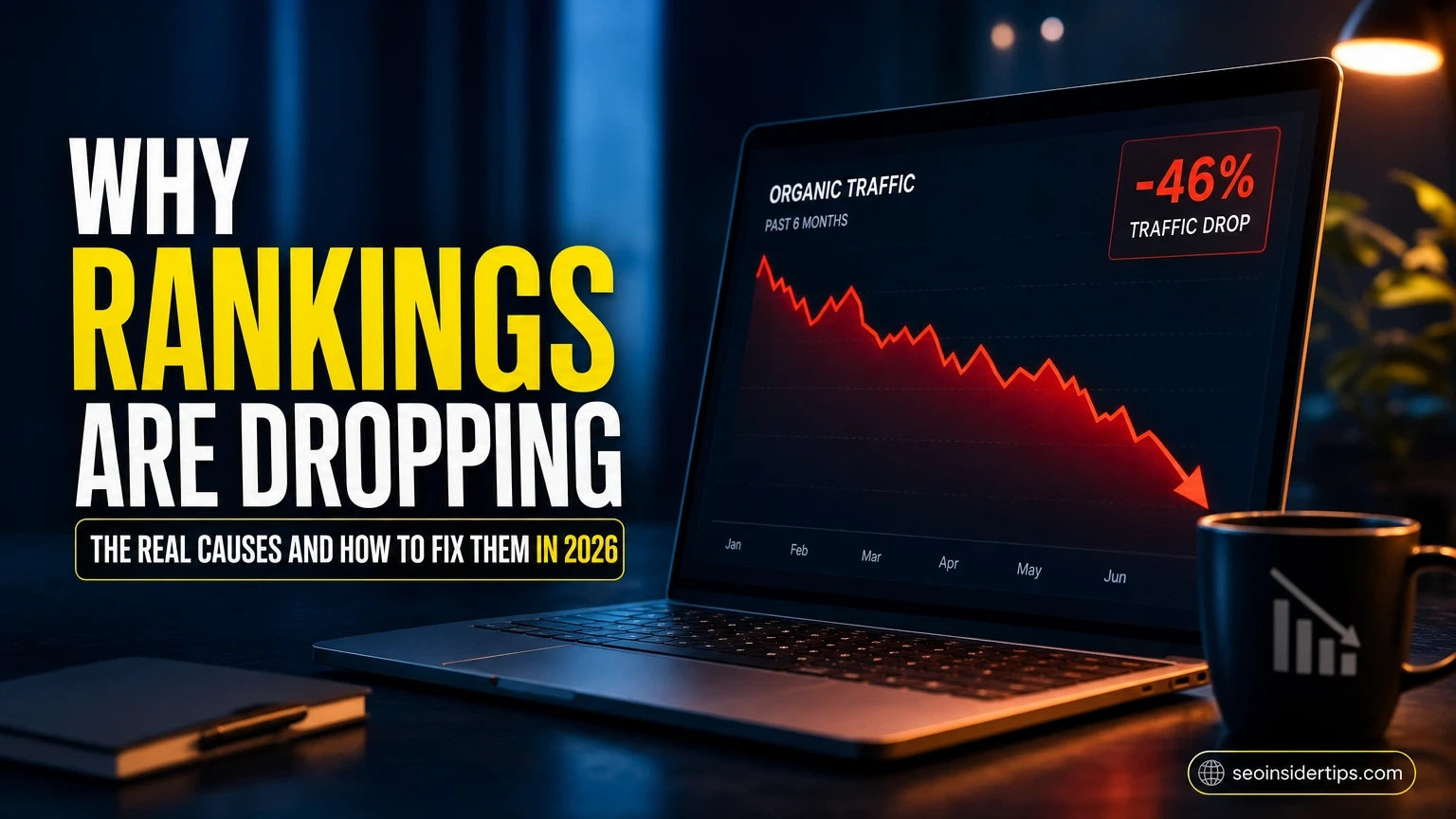
You check your analytics on a Monday morning and the traffic graph is pointing the wrong direction. Pages that held top-5 spots for months have slipped to page two. No algorithm update was announced. Nothing obvious changed. That sinking feeling is one of the most frustrating experiences in SEO.
The good news: ranking drops almost always have a traceable cause. This guide walks through the six most common reasons sites lose ground in 2026, with specific diagnostics and fixes you can act on today.
Your Content Stopped Matching What Searchers Actually Want
Search intent drift is the most underrated cause of ranking drops, and it catches experienced SEOs off guard. Google‘s understanding of a query evolves over time. A page that matched the dominant intent in 2023 may no longer match what the top results look like today.
Open Google Search Console and pull the Performance report for your dropping pages. Look at the queries driving impressions versus clicks. If your click-through rate has fallen below 3-4% on a position-3 result, the title and meta description are likely misaligned with current intent. That is a signal, not a coincidence.
Do a fresh SERP check on your target keyword. If the top 10 results are now listicles and your page is a 2,000-word essay, Google has re-classified the intent as “quick comparison.” The fix is restructuring, not rewriting from scratch. In most cases, adding a clear answer in the first 100 words and reformatting the page to match the SERP’s dominant format recovers 60-70% of lost traffic within 6-8 weeks.
One more thing to check: content freshness signals. If competing pages updated their publish dates in the last 90 days and yours shows 2022, that alone can push you down 3-5 positions on informational queries where recency matters.
A Google Core Update Specifically Targeted Your Site’s Weakness
Core updates are not random reshuffles. Each one tends to target a specific quality signal: helpful content, E-E-A-T (Experience, Expertise, Authoritativeness, Trustworthiness), or thin-page patterns. If your drop aligned with a confirmed update date, that is your first clue.
Cross-reference your traffic drop date with Google’s Search Central blog update history. A drop that started within 3-5 days of a confirmed rollout almost certainly ties to that update.
The 2024 helpful content update and the March 2025 core update both hit sites with high percentages of AI-generated, low-experience content. If more than 30% of your indexed pages have thin word counts (under 400 words) or no first-person perspective, you are vulnerable. The recovery path is not a quick fix. Google has said these sites typically need to improve content quality across the board and then wait for the next core update cycle, which runs every 2-4 months.
Technical Issues That Silently Kill Crawling and Indexing
Crawl Budget Problems
Large sites – anything over 500 pages – can burn crawl budget on low-value URLs. Faceted navigation, session ID parameters, and duplicate paginated pages are common culprits. Use Screaming Frog to crawl your site and filter for pages returning `200` status with thin content. If you find hundreds of near-duplicate URLs being indexed, you are wasting crawl budget that should go to your money pages.
The fix: consolidate with canonical tags or block parameter-generated URLs in your `robots.txt`. Sites that clean up crawl waste typically see re-indexing of important pages within 2-3 weeks.
Core Web Vitals Regression
A CWV regression is easy to miss because it often happens after a plugin update or a new ad placement, not a deliberate change. Check your LCP (Largest Contentful Paint) score in Google PageSpeed Insights. Google’s threshold for “good” LCP is under 2.5 seconds. If you slipped from 2.1s to 3.8s after a site change, that is a measurable ranking factor hit on mobile.
Accidental Noindex or Robots Block
It sounds basic, but a staging site accidentally pushed to production with `noindex` in the `
` or a `Disallow: /` in `robots.txt` has taken down entire domains. Always verify after deployments. A 10-minute check in Search Console’s URL Inspection tool can confirm whether Google can see your pages.Link Profile Changes That Shifted Your Authority
Backlinks are still one of Google’s top 3 ranking signals in 2026. A sudden drop in referring domains – even from natural link decay – can move rankings fast.
Pull your backlink profile in Ahrefs or Semrush and sort by “lost links” in the last 30-90 days. Look specifically for:
- Lost links from domains with a Domain Rating (DR) above 50
- Redirects that broke, sending link equity to a 404
- Competitor link acquisition that outpaced yours in the same period
A single lost link from a DR-80 news site can cost you 2-4 positions on competitive terms. If a major referring page was deleted or redirected away from your URL, reach out to the site owner and request a link restoration or update. Recovery rate on polite outreach is around 15-25%, which is worth the effort on high-authority links.
Also check whether your anchor text profile has shifted. If a disavow file was uploaded incorrectly, or a bulk link removal campaign went too far, you may have disavowed genuinely good links alongside toxic ones.
Competitor Improvements That Outpaced Your Standing
Sometimes your page did not get worse. Your competitors just got better. This is one of the most common reasons rankings slip quietly over 6-12 months without any clear trigger.
Run a gap analysis. Take the top 3 results for your target keyword and compare them directly against your page across four dimensions: word count, number of unique subtopics covered, page speed, and backlink count. Tools like Surfer SEO can automate most of this and show you a content score gap in under 5 minutes.
Typical findings: a competitor added 400-600 words covering subtopics you skipped, earned 8-10 fresh backlinks from industry publications, and improved their mobile LCP from 3.2s to 1.9s. Each of those changes is small. Together, they push them past you.
The response is not panic. Pick the highest-use gap – usually content depth – and close it first. A content refresh that adds 300-500 words of genuinely useful information, structured with clear H2s and FAQ schema, tends to show movement within 4-6 weeks.
The Most Common Causes at a Glance
Before exploring a full audit, it helps to triage. Here are the eight most frequent reasons rankings fall, ranked roughly by how often they appear in real site audits:
- Content intent mismatch with current SERP format
- Google Core Update targeting thin or low-experience content
- Lost high-authority backlinks (DR 50+)
- LCP or CWV regression after a site update
- Crawl budget waste from duplicate or low-value URLs
- Competitor content and link profile improvements
- Manual penalty (check Search Console’s Manual Actions report)
- Accidental `noindex` or robots block after a deployment
Run through this list in order. Most sites find their root cause within the first three items. Manual penalties are rare – fewer than 1% of ranking drops – but take 30 seconds to rule out in Search Console, so always check.
Diagnosing a Drop Before You Touch Anything Else
The single biggest mistake site owners make is changing content or structure immediately after noticing a drop. That creates noise. You end up not knowing whether the recovery (or further decline) came from your change or from Google finishing a re-crawl.
Start with a 72-hour observation window. Pull the exact drop date from Search Console’s Performance report by switching to “Compare” mode. Note the date, the affected pages, and the queries that lost impressions first. Queries losing impressions before clicks drop usually point to indexing issues. Clicks dropping while impressions hold steady usually points to CTR problems – title tags, meta descriptions, or structured data changes.
Then build a simple audit checklist: indexing status, CWV scores, backlink changes, and a side-by-side SERP comparison. In my experience, 80% of drops have a clear cause visible within 20-30 minutes of focused diagnosis. The remaining 20% require deeper crawl analysis or waiting out an ongoing algorithm update, which can take 2-4 weeks to fully roll out.
Stopping the Slide: What Actually Works in 2026
Ranking drops feel urgent, and the temptation is to do everything at once. That rarely works. The sites I have seen recover fastest follow a sequenced approach: diagnose first, fix the highest-impact issue, wait 3-4 weeks for signals to process, then move to the next fix.
If the drop is tied to a core update, the timeline is longer – typically 2-3 months before meaningful recovery after making quality improvements. That is frustrating, but it is realistic. Chasing short-term signals during an update cycle often makes things worse.
The most durable protection against future drops is building what Google has consistently rewarded: original analysis, clear E-E-A-T signals, fast pages, and earned links from relevant sources. Sites that invest in those four areas see fewer drops and recover faster when they do happen. If you want to go deeper on protecting your rankings long-term, understanding how to build a stronger internal linking structure and a healthier technical foundation are the two most impactful next steps.
When you implement Why rankings are dropping, revisit the checklist above against your real constraints.
Frequently asked questions
How long does it take to recover rankings after a Google Core Update?
Recovery after a core update typically takes 2-4 months. Google processes quality improvements over time and usually validates them during the next core update cycle. Making genuine content improvements is the right move, but expect a wait rather than an immediate bounce-back.
Can a single lost backlink cause a ranking drop?
Yes, especially if it came from a high-authority domain (DR 60+) and was one of your few strong referring links for that page. A single lost editorial link from a major publication can move rankings by 3-5 positions on competitive keywords. Monitor your backlink profile in Ahrefs or Semrush at least monthly.
Why are rankings dropping even though I haven’t changed anything?
Inaction is itself a cause. Competitors update their content, earn new links, and improve their page speed while your page stays static. Google’s index is a relative ranking – if others improve and you don’t, you slide. Check competitor pages for recent updates and compare them against yours.
How do I tell if a technical issue or content issue caused my drop?
Look at which pages dropped and what they have in common. If a wide range of pages across different topics all dropped at once, suspect a technical issue (crawl block, CWV regression, sitewide penalty). If specific pages on specific topics dropped, the cause is more likely content-related or tied to a niche-specific algorithm update.
Should I use the disavow tool if I suspect bad links are hurting me?
Use the disavow tool carefully and only as a last resort. Incorrectly disavowing good links can cause more damage than the toxic ones you were targeting. Before disavowing, attempt manual removal outreach first. If you do use Google’s Disavow Tool, have an experienced SEO review the file before submitting it.



Leave a Reply