
Most off-page checklists are padded with busywork. Directory submissions, blog comments, forum signatures – none of it has mattered since Google’s link-spam algorithms got good. The off page seo checklist that actually works is shorter and more boring than people want it to be.
This guide ranks what’s left by impact and effort, so you know what to do this week and what to skip entirely. It’s built for site owners who have a few hours a month, not an agency retainer.
Separate Link Building From Digital PR
Link building and digital PR get lumped together, but they’re different jobs with different success rates. Link building means actively asking for links: guest posts, resource page outreach, broken link replacement. Digital PR means creating something worth covering, then pitching journalists or niche writers who’d want to mention it anyway.
For small sites, digital PR usually wins on cost per quality link. A single original dataset, survey, or tool that solves a narrow problem can earn coverage from several sites in one push. Link building outreach, by contrast, often needs 30-50 emails to land a handful of placements, and most of those placements are on sites with thin editorial standards.
That doesn’t mean skip outreach. It means sequence it correctly: build one genuinely citable asset first (a calculator, an original survey, a comparison based on real testing), then use direct outreach only for links that asset won’t attract on its own, like resource page mentions or partner directories in your actual industry.
Google’s own guidance on link schemes is blunt about this trade-off. Per Google’s link spam documentation, links exchanged for compensation, automated link-building services, and excessive reciprocal linking can trigger manual or algorithmic action. The asset-first approach sidesteps that risk because the links come in without being negotiated.
Audit Your Existing Backlink Profile First
Before building anything new, check what you already have. A backlink audit tells you if you’re starting from zero or from a hole.
Pull your backlink data from Google Search Console under Links > Top linking sites, then cross-reference with a third-party crawler like Ahrefs or Semrush for anchor text distribution and referring domain quality. Search Console shows what Google has indexed; the third-party tools show link velocity and spam scores Google doesn’t expose directly.
Flag two things specifically. First, anchor text that’s over-optimized – if 40% of your links use the exact phrase “best running shoes for flat feet,” that’s a pattern a manual reviewer or algorithm notices. Second, links from clearly unrelated or low-quality domains, especially ones you don’t recognize and never requested.
Most sites don’t need a disavow file. Google’s algorithms, particularly Penguin’s real-time integration into core ranking systems, already discount spammy links rather than penalizing the whole site for them. Reserve the disavow tool for cases where you’ve received a manual action notice tied to unnatural links, or where you ran a sketchy campaign years ago and want a clean slate before a new push. For everyone else, it’s wasted effort – you’re asking Google to ignore links it’s probably already ignoring.
Fix Technical Signals That Undercut Off-Page Work
A link only transfers value if Google can actually credit the page it points to. Technical gaps quietly waste a chunk of every off-page campaign.
Check canonical tags first. If a linked page has a <link rel="canonical"> pointing somewhere else, external link equity consolidates to the canonical target, not the page people actually linked to. Run a crawl in Screaming Frog and filter for pages with inbound external links where the canonical doesn’t match the URL itself.
<link rel="canonical" href="https://example.com/correct-page/" />This tag tells Google which URL is the “real” version when duplicates exist – get it wrong on a linked page and you’re routing authority somewhere you didn’t intend.
Second, check for redirect chains. A link pointing to a URL that 301-redirects through two or three hops still passes value, but each hop adds latency and occasionally gets dropped from a recrawl entirely. Fix multi-hop chains so external links resolve in a single redirect.
Third, confirm the linked page isn’t accidentally noindex. This happens more than people expect, usually after a CMS migration or a staging-to-production push that left a stray meta tag behind.
<meta name="robots" content="noindex, follow">A page with this tag can still pass link equity through its own outbound links, but it won’t rank itself – so if your backlinks point to a noindexed page, that specific URL gets zero ranking benefit from them.
Build Digital PR Assets Worth Linking To
This is the highest-use section in the whole checklist, and the one most small sites skip because it takes real production time.
An asset worth linking to does one of three things: answers a question with original data, solves a task better than existing free tools, or documents something nobody else has documented. A regional pricing survey, a free calculator for a niche calculation your competitors charge for, or a teardown of how a specific process actually works in practice – these get cited because citing them saves the linking site work.
Here’s a worked example. A home services site runs a survey of 150 local contractors asking what permit delays actually cost homeowners, publishes the raw breakdown by project type, and pitches it to three local news outlets and two trade publications. One picks it up. That one placement, from a site with real editorial standards, is worth more than twenty guest posts on marketing blogs nobody reads.
The mistake most sites make here is treating the asset as a one-time project instead of an update cycle. A dataset that’s two years stale stops attracting new coverage and existing links start pointing to outdated numbers. Rebuild or refresh annually if the topic is volatile (pricing, regulations, rankings); every few years is fine for anything more stable.
Strengthen Brand Signals Beyond Links
Google’s helpful content guidance increasingly weighs signals that aren’t links at all – mentions, reviews, and consistent entity presence across the web. Per Google’s guidance on creating helpful, reliable, people-first content, demonstrating real-world expertise and trustworthiness matters as much as the links pointing at a site.
Unlinked brand mentions count here even without an anchor text link. If a publication names your company in a roundup without hyperlinking it, that’s still a signal Google’s systems can associate with your entity, particularly when it shows up alongside your official site in a knowledge panel or local pack. Track these with a mentions monitor like Google Alerts or a paid tool, and when you find a strong unlinked mention on a site that accepts edits, it’s worth a polite ask for a link – low effort, often a yes.
Reviews matter too, especially for local and e-commerce sites. A Google Business Profile with consistent, recent reviews is a trust signal that compounds alongside your backlink profile rather than competing with it. Respond to reviews, keep the profile categories accurate, and don’t let it go stale for months at a time.
Off-Page Tasks Worth Repeating Monthly
Some off-page work isn’t a one-time project – it’s a maintenance habit. These are the tasks worth turning into an actual recurring checklist, because skipping a month compounds into a real gap.
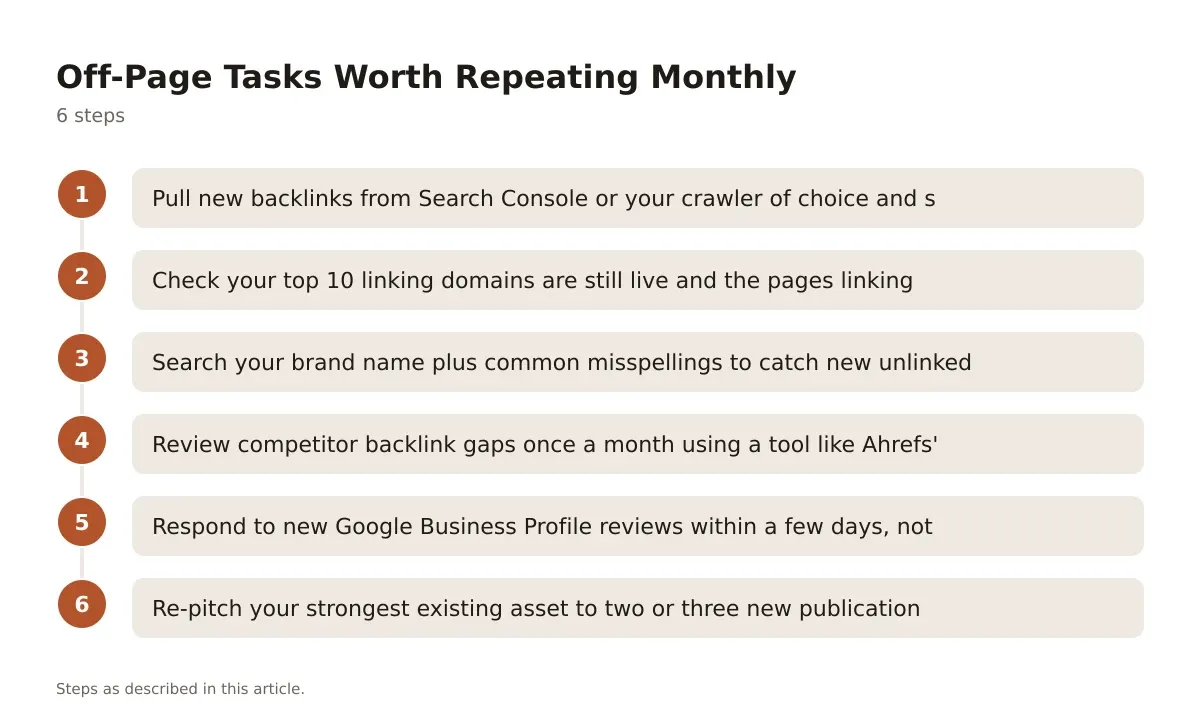
- Pull new backlinks from Search Console or your crawler of choice and scan for anything that looks spammy or unnaturally placed.
- Check your top 10 linking domains are still live and the pages linking to you haven’t been deleted or redirected.
- Search your brand name plus common misspellings to catch new unlinked mentions worth converting.
- Review competitor backlink gaps once a month using a tool like Ahrefs’ Content Gap report, looking only for domains relevant to your actual niche.
- Respond to new Google Business Profile reviews within a few days, not weeks.
- Re-pitch your strongest existing asset to two or three new publications you haven’t contacted yet.
Skip anything that isn’t on this list if you’re short on time. Social media posting schedules, forum participation, and manual directory submissions don’t move the needle enough to justify a recurring slot.
Choosing Between DIY, Freelance, and Agency Link Building
DIY outreach
This works when you have the time and the writing skill to pitch your own assets. It’s free in cash terms but expensive in hours – expect several hours per week if you’re doing it properly, including research, personalized pitches, and follow-up. It’s the right choice for a site owner who understands their niche better than any freelancer would, and who can speak credibly to journalists about it.
Freelance link builders
A freelancer or small outreach specialist costs less than an agency and can execute a defined campcampaign (a set number of pitches against a specific asset) without the overhead of a full agency relationship. The risk is quality control – vet their portfolio for real, relevant placements, not just a high link count. Ask for the actual URLs they’ve landed on past campaigns, not just a client list.
Agency retainers
Agencies make sense once you’ve outgrown ad hoc outreach and need consistent monthly output across content creation, pitching, and reporting. They’re not for sites with no existing content worth promoting – an agency pitching a thin, outdated page will get the same rejection rate you would. Get a scope of deliverables in writing (number of placements, domain rating minimums, reporting cadence) before signing anything, since “SEO services” as a line item means almost nothing without specifics.
What to Deliberately Skip This Year
A few tactics still show up in older checklists and keep wasting people’s time. Skip them.
Directory submissions outside your actual industry associations don’t carry meaningful weight anymore; most are either ignored by Google or actively flagged as low-quality link farms. Blog comment links with a keyword-stuffed anchor almost always carry nofollow or ugc attributes now, meaning they pass no direct ranking signal at all. Private blog networks (PBNs) are explicitly called out in Google’s spam policies as a link scheme that can trigger manual action against the entire site, not just the offending page. Paid guest posts on networks that openly sell placements on dozens of unrelated sites fall into the same bucket – the pattern is obvious to anyone (or anything) auditing a link profile.
If you’re already running any of these, the fix isn’t necessarily a disavow – it’s stopping the behavior and redirecting that budget toward one piece of original research or one properly pitched digital PR asset instead.
Measuring Whether Off-Page Work Is Actually Paying Off
Tracking off-page SEO by raw link count is close to useless. A better set of metrics: growth in referring domains (not total backlinks, since one domain can link dozens of times), organic traffic to the specific pages you targeted with outreach, and keyword position movement for terms tied to those pages.
Set a baseline before starting any campaign, using Search Console’s Performance > Search results report filtered to the target URL, then re-check at 60 and 90 days. Off-page impact is slow by nature, since Google needs to recrawl and reprocess the linking pages before the new signal counts, and ranking movement afterward can take several more weeks depending on how competitive the query is. Don’t judge a campaign at the 30-day mark; you’re measuring noise, not signal, at that point.
Referring domain growth from relevant, topically-aligned sites is the strongest leading indicator available. If your domain growth is flat but your overall backlink count is climbing, check where those new links are coming from – that pattern often means low-quality, bulk-acquired links rather than a healthy profile.
Building an Off-Page Routine That Fits Your Time Budget
Off-page SEO rewards focus more than volume. A small site that builds one strong digital PR asset a year and keeps its backlink profile clean will usually outperform a site that scatters effort across comment links, directories, and low-effort guest posts. Pick the two or three highest-use items from this checklist, the technical audit, the asset build, and the monthly monitoring, and treat everything else as optional.
If you’re building out a broader SEO process and want to see how off-page work fits alongside on-page and technical priorities, this full SEO checklist covering on-page, off-page and technical work walks through the sequence in more detail.
The sites that struggle with off-page SEO almost always have the same root problem: they’re chasing link count instead of relevance and citability. Fix that mindset first, and the checklist above becomes much easier to execute consistently.
Frequently asked questions
What’s the difference between an off page SEO checklist and a link building checklist?
Off-page SEO is the broader category – it includes link building, but also brand mentions, reviews, digital PR, and entity signals that don’t involve a hyperlink at all. A link building checklist is narrower and focuses only on acquiring backlinks. Treating them as the same thing is why a lot of off-page work ends up overweighted on links and underweighted on everything else Google’s systems consider.
How many backlinks does a small site need to rank?
There’s no fixed number, and any tool or article claiming otherwise is guessing. Relevance and quality of referring domains matter more than count – a handful of links from topically relevant, trusted sites regularly outperforms dozens of links from low-quality or unrelated domains. Focus on the competitiveness of your target keywords rather than a link target.
Should I disavow spammy backlinks I didn’t ask for?
Usually not. Google’s ranking systems, including the Penguin signals folded into core search algorithms, already discount most spam links without penalizing the site they point to. Reserve the disavow tool for sites that received an actual manual action notice tied to unnatural links, or a known history of manipulative link buying that needs a documented clean-up.
How long does off-page SEO take to show results?
Expect to wait at least 60 to 90 days after a link or mention goes live before judging its impact, since Google needs to recrawl the linking page and reprocess the signal. Competitive keywords can take longer, sometimes several months, depending on how established the competing pages are. Judging a campaign at 30 days almost always produces a false negative.
Do nofollow links still help SEO at all?
They don’t pass direct ranking signal the way a followed link does, but they still contribute to a natural-looking link profile and can drive real referral traffic, which itself is a usage signal. Google has stated it treats nofollow, sponsored, and ugc attributes as hints rather than strict directives, meaning some of these links may still be considered in certain contexts. Don’t chase them deliberately, but don’t dismiss them as worthless either.



Leave a Reply