
Most AI SEO tools won’t write you a single sentence that ranks on their own. What they’re actually good at is scoring a draft against the pages already sitting on page one, in seconds instead of hours of manual SERP digging.
That’s the real pitch behind this category. Not “AI writes your content,” but “AI tells you what’s missing from it.” Six tools dominate this space right now, and each one solves a slightly different problem for a slightly different team.
What makes a tool “AI SEO” instead of just SEO software
AI SEO tools use natural language processing (NLP) to read the content already ranking for a keyword and extract patterns: terms, entities, headings, and structure. That’s different from a keyword research tool that just gives you search volume.
The practical difference shows up in the workflow. A traditional tool tells you “target this keyword, here’s the volume.” An AI content tool tells you “here are 40 terms the top 10 results use that your draft doesn’t, and here’s a score out of 100.” Surfer SEO built its entire product around that scoring loop. Clearscope does something similar but leans harder into readability and grading for editorial teams.
Neither replaces judgment. A high content score doesn’t guarantee a ranking. Google’s own helpful content guidance is explicit that content needs to serve the reader first, not just hit term-matching targets. Treat the score as a checklist, not a finish line.
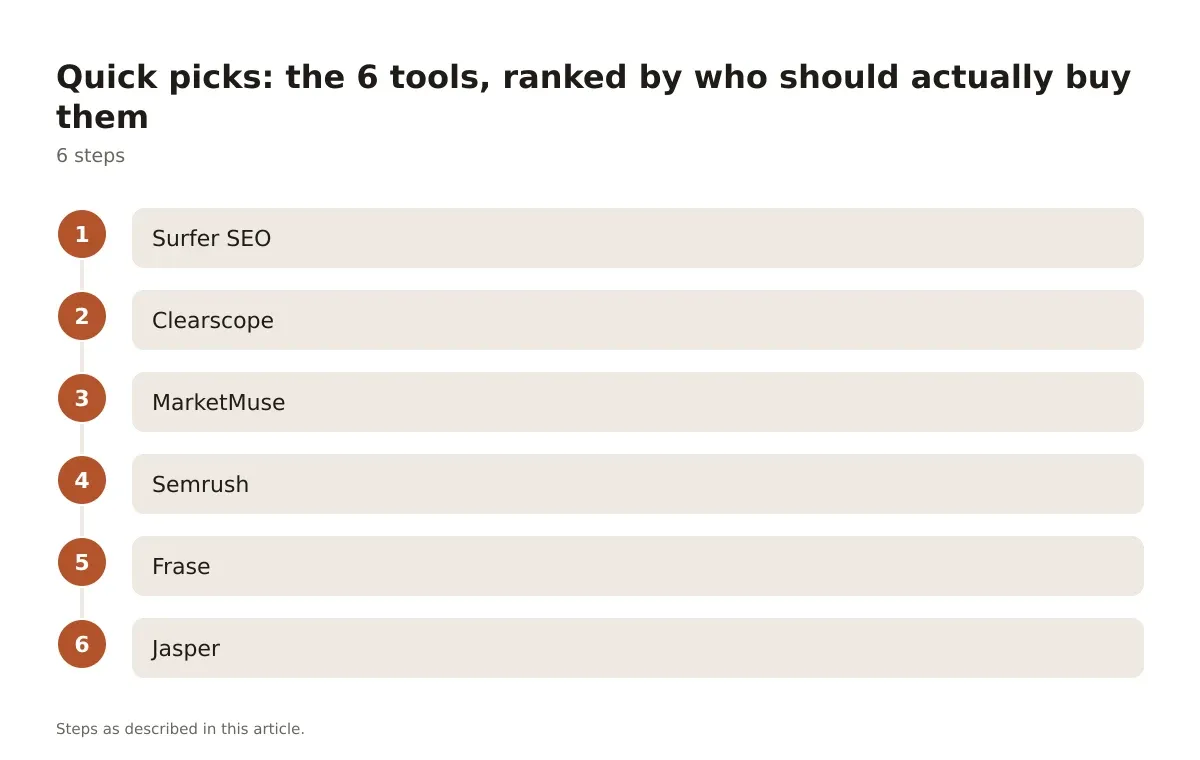
Quick picks: the 6 tools, ranked by who should actually buy them
- Surfer SEO – best for teams who want a live content score while writing, integrated directly into Google Docs or WordPress.
- Clearscope – best for agencies and editorial teams that need clean, shareable content grades for clients or writers.
- MarketMuse – best for enterprise teams auditing hundreds or thousands of existing pages for content gaps.
- Semrush – best for anyone who wants SEO research, site audits, and AI content scoring in a single subscription.
- Frase – best for solo writers and small teams who need a fast brief and a draft without a big learning curve.
- Jasper – best for marketing teams producing high-volume content who already have an SEO scoring tool like Surfer SEO feeding it direction.
Surfer SEO: real-time scoring while you write
Surfer SEO is built around one screen: the Content Editor. You paste in a target keyword, and it scores your draft in real time against the pages currently ranking on page one.
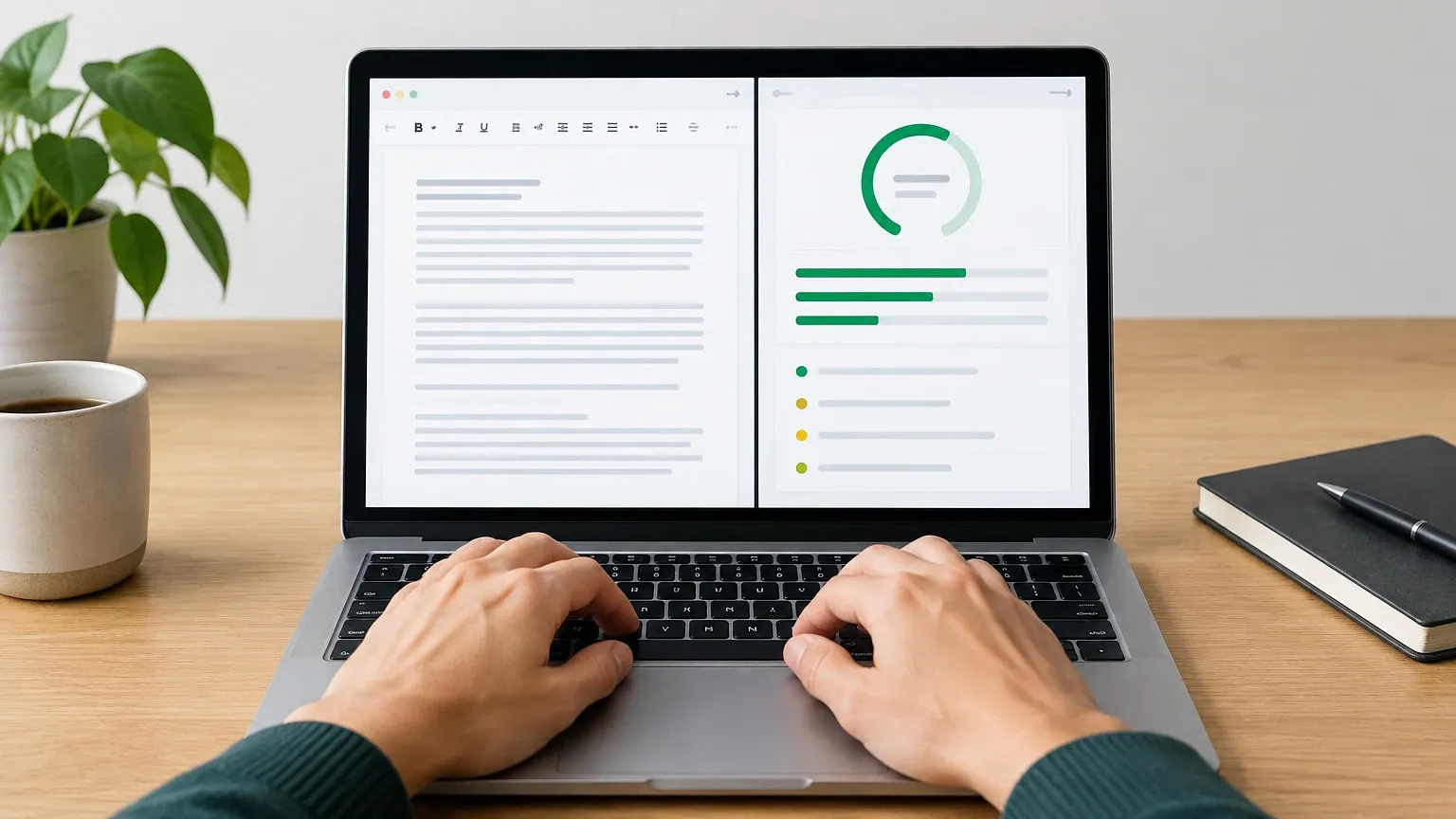
The scoring isn’t cosmetic. It flags term frequency, word count range, heading structure, and even image counts, based on what the top-ranking pages are doing. Writers watch the number climb as they add the terms it’s missing. That immediate feedback loop is the main reason agencies adopt it: you can hand a writer a brief and a live score instead of reviewing drafts after the fact.
Surfer’s SERP Analyzer and Audit tools extend this into existing content, flagging pages that have drifted from what’s currently ranking. The Google Docs, WordPress, and Jasper integrations mean you rarely leave your writing environment to check a score.
Where it falls short: Surfer’s scoring model rewards pattern-matching against current SERPs, which means two different writers chasing the same keyword can end up producing suspiciously similar structures. It’s also easy to over-optimize toward the score and under-optimize for the actual reader. Pricing on request. For a broader rundown of what’s worth paying for versus what you can skip entirely, our guide on free versus paid SEO tools covers that trade-off in more depth.
Clearscope: the content-grading tool agencies hand to freelancers
Clearscope’s whole design philosophy is handing a clean, visual grade to someone who isn’t an SEO specialist. A freelance writer with zero SEO background can open a Clearscope report and understand immediately what an A versus a C grade means.
Under the hood, it’s doing the same NLP-based term extraction as Surfer, comparing your draft against top search results. The difference is presentation: Clearscope’s reports read like a teacher’s grading rubric, with a clear letter grade, a term list sorted by relevance, and readability flags. The Google Docs and WordPress integrations let you grade in-editor, which matters when you’re managing a roster of outside writers who won’t learn a new platform.
It also includes keyword discovery and a reporting dashboard, so content leads can track how a piece performs after publishing, not just how well it scored pre-publish.
The trade-off: Clearscope is weaker on technical site auditing. It’s a content-grading tool, full stop, not an all-in-one SEO platform. If you need crawl data, backlink analysis, or rank tracking alongside your content scoring, you’re buying a second tool regardless. Pricing on request.
MarketMuse: content strategy at the domain level, not the page level
MarketMuse’s angle is different from the first two. Instead of scoring one draft against one SERP, it analyzes your entire site’s content inventory and models the topics you’re missing, thin on, or duplicating.
This matters most for sites with hundreds or thousands of pages, where the problem isn’t “optimize this one article” but “we have 40 pages half-covering the same topic and no clear pillar page.” MarketMuse’s Research, Optimize, and Connect tools are built around that scale: content gap analysis across a whole domain, competitive analysis against rival sites, and AI-generated briefs based on what the topic model says you’re missing.
Pro tip: run a MarketMuse content inventory before a site migration or major redesign. Catching topic duplication before you restructure URLs saves a painful second cleanup pass later.
It’s overkill for a five-person blog. The topic modeling needs enough existing content to analyze meaningfully, and the learning curve is steeper than Frase or Clearscope. This is an enterprise tool wearing a content tool’s clothing. Pricing on request.
Semrush: the all-in-one platform with AI content scoring bolted on
Semrush isn’t primarily an AI content tool. It’s a full SEO suite, keyword research, site audits, backlink analysis, rank tracking, that happens to include an AI-powered SEO Writing Assistant and a Content Marketing Toolkit.
That’s precisely why it fits a particular buyer: the in-house marketer or small agency who doesn’t want five separate subscriptions. You get competitive intelligence for traffic and keyword gaps, technical audit flags, and content scoring, all under one login. The Writing Assistant checks readability, tone, originality, and SEO basics while you draft, though it’s noticeably less granular than Surfer’s term-by-term scoring.
The honest trade-off: if content optimization is your main job, Surfer or Clearscope will out-perform Semrush’s writing assistant on depth. Semrush wins on breadth, not depth, in the content-scoring category specifically. It’s the right call when content tooling is one need among many, not the whole job. Pricing on request.
Semrush vs. Surfer SEO vs. Clearscope: three different jobs
| Tool | Core job | Best fit | Weak spot |
|---|---|---|---|
| Semrush | All-in-one SEO suite with content scoring | Teams needing audits, rank tracking, and content tools in one login | Content scoring less granular than dedicated tools |
| Surfer SEO | Real-time content scoring vs. live SERPs | Writers and agencies optimizing drafts as they’re written | Scores can push toward sameness across competitors |
| Clearscope | Content grading for editorial workflows | Agencies managing freelance writers at scale | No technical audit or rank tracking features |
This isn’t a “pick one winner” comparison. Teams running high page volume often end up with Semrush for the technical and research layer, then a dedicated content scorer like Surfer or Clearscope on top for the drafting stage.
Frase: the fastest brief-to-draft workflow for small teams
Frase solves a narrower, more specific problem: a solo writer or two-person content team who needs a brief built fast, without the overhead of an enterprise platform.
Drop in a target keyword, and Frase pulls the top-ranking pages, extracts common questions and subtopics, and builds a brief automatically. Its built-in AI writing assistant can then draft sections directly from that brief, which shortens the gap between “I have a keyword” and “I have a publishable draft.”
Frase also tracks Answer Engine Optimization (AEO) analytics, which matters more now that AI Overviews and chat-based answer engines are pulling traffic away from traditional blue links. If you’re trying to understand how your content performs in those surfaces, not just in classic rankings, that’s a feature none of the other five tools here lead with directly. Our guide on getting featured in Google’s AI Overviews goes deeper into what that actually takes.
Frase’s weakness is depth at scale. It’s built for speed on individual articles, not for auditing a 500-page site or managing a large freelance roster with strict grading rubrics. Pricing on request.
Jasper: content generation at volume, paired with an SEO scorer
Jasper is the odd one out on this list because it’s not primarily an SEO tool. It’s an AI writing platform built for marketing teams producing content at volume, blog posts, ad copy, long-form pieces, with brand voice customization baked in.
Its SEO relevance comes from the integration: Jasper’s SEO mode connects to Surfer SEO, pulling in that real-time content score while you generate copy. That pairing is deliberate. Jasper handles volume and voice consistency; Surfer handles the term-matching and structure scoring. Teams that need both often run them together rather than picking one.
⚠️ Warning: AI-generated drafts that are published with minimal editing tend to read generically, and Google’s helpful content systems are explicitly built to deprioritize content that doesn’t demonstrate real expertise or added value. Treat Jasper’s output as a first draft, never a final one.
The templates for blog posts and ad copy speed up ideation, but brand voice customization takes real setup time to get right, it’s not accurate out of the box. Pricing on request.
Common mistakes teams make picking between these tools
Buyers in this category tend to make the same handful of errors, and they’re avoidable once you’ve seen them play out.
The first is chasing the content score as the goal itself. A Surfer score of 90 or a Clearscope A-grade means your draft pattern-matches the current SERP, not that it will outrank it. Google’s ranking systems weigh dozens of other signals, including backlinks, page experience, and actual topical authority, that no content scorer measures.
The second mistake is buying enterprise tooling for a small site. MarketMuse’s domain-level modeling needs real content volume to produce useful output. A 20-page site won’t get much value from it yet.
The third is skipping the free trial and committing on marketing copy alone. Every tool on this list offers a trial or demo; actually load in a real page from your site and see what the score suggests before you commit budget.
The fourth is assuming AI writing output is publish-ready. Jasper and Frase both draft fast, but unedited AI output tends to read flat and generic, exactly the pattern Google’s quality systems are built to spot.
How to pick the right tool for your actual team size
Start with team size and workflow, not feature lists. A solo blogger or small business owner needs speed and simplicity, which points toward Frase. An agency managing freelance writers across multiple clients needs grading clarity, which points toward Clearscope.
A large in-house team juggling technical audits, rank tracking, and content all at once is better served by Semrush’s breadth than by stitching together three separate subscriptions. An enterprise team sitting on a content library of hundreds of pages, trying to find gaps and duplication, needs MarketMuse’s domain-level modeling, not a single-page scorer.
If your bottleneck is writing volume rather than optimization precision, Jasper paired with Surfer SEO’s scoring handles both halves of that problem at once. Match the tool to the actual bottleneck, not to whichever one has the flashiest demo video.
Setting realistic expectations for what AI scoring actually changes
None of these tools move a ranking by themselves. What they change is how fast you can identify what a competing page is doing that yours isn’t, structurally and lexically.
A realistic workflow looks like this: research the keyword, pull a brief or score from one of these tools, write toward it with your own expertise and judgment, then let a human editor catch the places where the optimization pass made the writing stiff or repetitive. Skip that last step and you’ll often ship a piece that scores well but reads like it was written for software, not people.
Results depend heavily on the site’s existing authority, the competitiveness of the keyword, and whether the content genuinely answers the query better than what’s already ranking. A perfect content score on a brand-new site with no backlinks and no topical history will not out-rank an established competitor. Treat these tools as drafting aids, not shortcuts around the fundamentals.
Picking a tool without overbuying the category
The honest summary here is that nobody needs all six of these. Most sites need exactly one content scorer, paired with whatever technical SEO tooling they already run, and maybe a writing assistant if volume is the bottleneck.
Start cheap and specific: a solo operator should try Frase before anything else. A content agency juggling writers should demo Clearscope. A team already paying for Semrush should max out its built-in content tools before adding a second subscription on top. Only step up to MarketMuse or a Jasper-plus-Surfer combination once volume or domain size actually demands it.
The category will keep shifting as AI Overviews and chat-based search change what “ranking well” even means, but the underlying discipline doesn’t change: these tools tell you what the competition is doing, not what your reader actually needs. Keep a human in the loop on every draft, and treat the score as a floor, not a ceiling.
Pricing verified 2026-10-08. Check the vendor site for the latest.
Frequently asked questions
Do AI SEO tools guarantee higher rankings?
No tool on this list can guarantee a ranking. They score content against current competitors and flag gaps, but rankings depend on backlinks, site authority, page experience, and dozens of other signals these tools don’t measure directly.
Can I use more than one of these tools together?
Yes, and many teams do. A common combination is Semrush for technical audits and research, paired with Surfer SEO or Clearscope for content scoring, since each tool is solving a different part of the workflow rather than competing directly.
Will Google penalize AI-generated content from these tools?
Google’s guidance focuses on whether content is genuinely helpful, not on whether AI assisted in writing it. Thin, unedited AI drafts published purely to rank tend to get deprioritized by Google’s quality systems, so the editing and expertise layer still matters.
Which tool is best for a small business with one blog?
Frase usually fits best, since it’s built for speed and simplicity without an enterprise learning curve. Clearscope is a reasonable alternative if you’re managing a couple of freelance writers and need a simple grading system.
Do these tools replace keyword research tools?
Not entirely. They work from a target keyword you’ve already chosen, so most teams still run dedicated keyword research first before feeding a term into one of these content scorers.



Leave a Reply