
Here’s an uncomfortable truth: you can’t actually improve your “domain authority” with Google, because Google doesn’t use it. What you can improve is the underlying thing that score is trying to estimate, which is how much of the web trusts your site enough to link to it. Once you check domain authority the right way, with the right tool and the right expectations, it becomes a useful compass instead of a vanity number.
This guide covers how to check domain authority for free, what separates DA from DR, which tools are worth your time, and what actually moves the needle. No shortcuts, no spam tricks, just the link-building work that tends to hold up over time. If you want the broader context first, our topical authority seo guide covers the content side of this equation.
What domain authority actually measures
Domain Authority (DA) is a metric built by Moz, not Google. It’s a logarithmic score from 1 to 100 that predicts how well a site is likely to rank in search results, based on the quantity and quality of its backlink profile. Moz trains it against actual search engine rankings as a reference point, which is why it correlates loosely with performance without being a ranking factor itself.
That distinction matters more than most articles admit. Google has said plainly, through its own spam policies documentation, that it does not use third-party metrics like DA to evaluate sites. DA is a proxy, trained on crawl data that’s a snapshot, not real-time. Two sites with identical link profiles can show different DA scores on different days simply because Moz recrawled one before the other.
So why bother? Because DA is a decent shorthand for conversations with clients, for comparing your site against competitors, and for tracking whether your link building is trending in the right direction over months. It’s a dashboard number, not a report card Google is grading.
DA vs DR: what’s the real difference
People use these terms interchangeably and that’s the first mistake. DA comes from Moz. DR (Domain Rating) comes from Ahrefs. They’re built on different link indexes, different algorithms, and different scales of “what counts as a quality link.”
How Moz calculates DA
Moz’s score leans on its own Link Explorer index and weighs factors like the number of linking root domains, the quality of those domains, and historical data trends. A site with fifty links from mid-tier blogs might score similarly to a site with five links from major publications, depending on how Moz’s model weighs diversity versus raw authority.
How Ahrefs calculates DR
DR looks only at backlinks pointing to the domain, scored on a 0-100 logarithmic scale based on the quantity and quality of unique referring domains. Ahrefs maintains one of the largest independent link indexes on the web, crawling billions of pages regularly, which means DR often reacts faster to new links than DA does.
Why the numbers never match
A domain can show DA 35 and DR 48 at the same time, and neither number is “wrong.” They’re measuring the same concept with different data and different math. The mistake is treating either score as an absolute truth instead of a directional signal you track against your own historical baseline.
How to check domain authority for free
You don’t need a paid subscription to check domain authority or DR on a regular basis. Here’s the actual workflow:
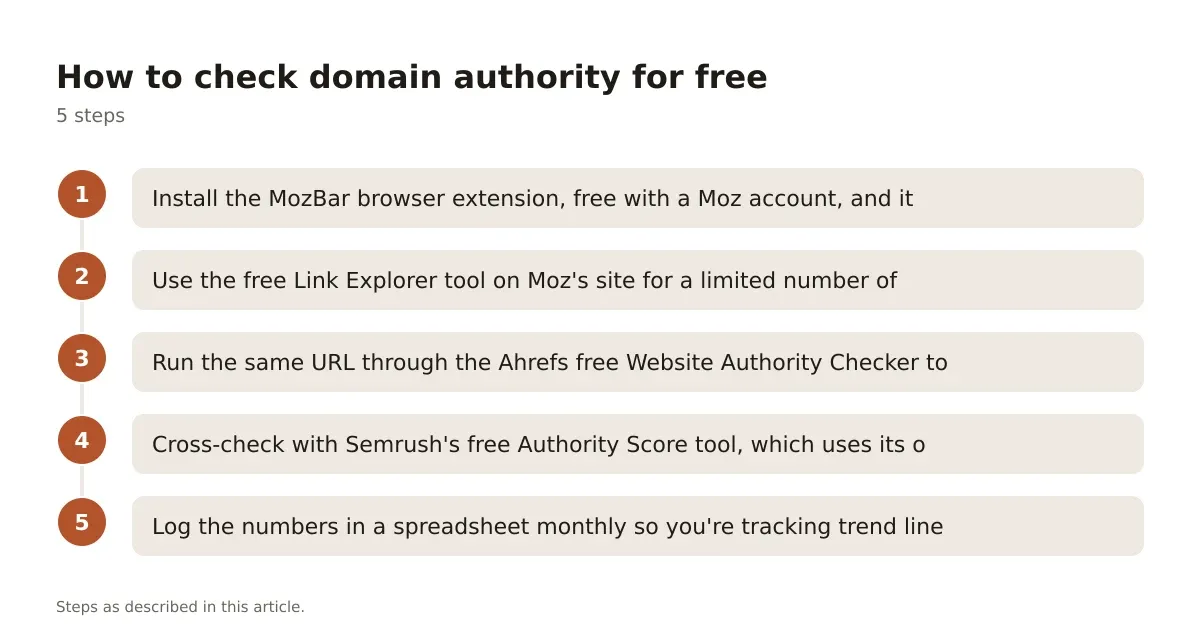
- Install the MozBar browser extension, free with a Moz account, and it shows DA and Page Authority directly in search results and on any page you visit.
- Use the free Link Explorer tool on Moz’s site for a limited number of lookups per day without a paid plan.
- Run the same URL through the Ahrefs free Website Authority Checker to get a DR reading alongside backlink and referring domain counts.
- Cross-check with Semrush‘s free Authority Score tool, which uses its own blended metric pulling from organic traffic, backlinks, and spam signals.
- Log the numbers in a spreadsheet monthly so you’re tracking trend lines, not single snapshots.
None of these lookups require you to buy a subscription just to check domain authority once in a while. Save the paid plans for when you need deep backlink audits or competitor gap analysis.
Picking the right authority checker for your site
Not every tool suits every site owner, and that’s worth saying plainly before you pick one.
Quick-picks list
- MozBar – best for quick DA checks while browsing competitor sites.
- Ahrefs Website Authority Checker – best free DR lookup with referring domain detail.
- Semrush Authority Score – best when you also want traffic estimates alongside the score.
- Ubersuggest – best for solo operators who want a lightweight, low-cost dashboard.
- Majestic – best if you care about Trust Flow and Citation Flow as a separate lens on link quality.
Who each tool is NOT for
MozBar is light on raw backlink detail, so don’t rely on it alone for a full link audit. Ahrefs’s free checker caps how much backlink data it shows without a paid seat, so agencies managing multiple client sites will outgrow it fast. Semrush’s Authority Score blends in traffic data, which makes it less pure as a link-only metric if that’s specifically what you’re after. Majestic’s Trust Flow metric takes longer to learn and doesn’t map cleanly onto DA or DR, so it’s a poor first tool for beginners.
Why buying links wrecks your score faster than it builds it
Paid link schemes are exactly the kind of thing Google’s spam policies target directly, under what the documentation calls link spam: buying or selling links that pass ranking credit, excessive link exchanges, and automated program-generated links all qualify. Getting caught doesn’t just risk a penalty. It can also tank the very link profile you were trying to inflate, because once a manipulative network gets deindexed or flagged, every site tied to it loses the “linking domain” that was propping up its score.
Scaled content abuse is the modern version of this: mass-producing thin pages purely to house outbound or inbound links. Google’s guidance calls this out specifically as a violation, not a gray area. A small site chasing fifty new backlinks a month from a private blog network might see a short DA bump, then watch it evaporate when the network gets caught and deindexed six months later.
The honest math is that earned links from real, crawlable, indexed sites hold their value. Bought links are a loan against your own domain’s future, and the interest rate is brutal.
Earning links a small site can actually pull off
Outreach doesn’t require a huge budget, just consistency and a clear value proposition for the person you’re emailing.
Start with digital PR angles tied to original data. Even a simple customer survey of 50-100 respondents, published with a clear methodology, gives journalists and bloggers something concrete to cite. Second, build resource-page outreach lists: search intitle:"resources" + [your topic] and intitle:"useful links" + [your topic] to find pages actively curating links in your niche, then pitch a genuinely useful addition, not a generic “add my site” email. Third, look at competitor backlinks using a free backlink checkers tool to find sites that linked to a competitor’s guide but not yours, then reach out with something better.
Guest posting still works when it’s selective. One well-placed guest post on a genuinely relevant, moderately-trafficked site beats ten posts on low-quality content farms that exist only to sell placements.
A worked example: tracking DA growth over six months
Picture a local services site starting at DA 12 with nine referring domains, mostly directory listings. Over six months, the owner runs three outreach campaigns: one data-driven blog post that earns four organic links from industry blogs, one round of resource-page outreach that lands six placements, and a partnership with a local chamber of commerce site for a reciprocal mention.
By month six, referring domains climb to around twenty-two, and DA moves into the high teens or low twenties, not a dramatic leap, but a real one built on links that won’t vanish in a deindexing sweep. The DR reading from Ahrefs likely tracks a similar, though not identical, upward curve, because the new links are coming from indexed, trafficked sites rather than spun content.
This is the realistic pace for most small sites. Anyone promising a jump from DA 15 to DA 50 in a month is either selling you a link package headed for trouble, or inflating a metric that won’t hold once Moz’s crawler catches up.
Common mistakes that stall authority growth
The biggest mistake is checking the score weekly and reacting emotionally to noise. DA and DR update on their own crawl schedules, Moz’s index refreshes periodically and isn’t instant, so a single week’s dip often means nothing more than a recrawl timing issue.
The second mistake is chasing link quantity over relevance. A hundred low-quality directory links will barely move DA and can actually drag down your overall link quality ratio, since both Moz and Ahrefs weigh the proportion of spammy versus trustworthy domains in your profile.
The third mistake is ignoring internal link structure while obsessing over external links. A site with messy internal linking dilutes the authority those external links are trying to pass to deeper pages. Fixing crawl paths and making sure key pages aren’t buried five clicks deep does more for distributing authority than another round of outreach sometimes does. If pages aren’t even showing up in search to begin with, that’s a separate, more urgent problem worth diagnosing first.
When low authority isn’t actually a link problem
Sometimes a flat or low DA score isn’t a backlink shortage at all, it’s a sign that the site has deeper technical issues keeping pages out of the index in the first place. If your pages aren’t getting crawled or indexed consistently, no amount of outreach will show up in a meaningful DA bump, because the linked pages themselves aren’t competing in search. It’s worth ruling out indexing problems before assuming you need more links; our guide on why your website isn’t showing in Google Search walks through the usual culprits, from robots.txt blocks to canonical tag conflicts.
Building authority as an ongoing habit, not a sprint
Treat DA and DR the way you’d treat a credit score: useful for quick comparisons, misleading if you stare at it daily, and only moved by real behavior over real time. Check domain authority monthly, not weekly, and pair it with a referring-domains count so you understand why the number moved, not just that it did.
The sites that build durable authority tend to do a few boring things consistently: publish something worth citing, pitch it to people who’d genuinely want to link to it, and keep the technical foundation clean enough that search engines can actually find and index what you’re building. None of that is glamorous, and none of it promises a specific ranking outcome, because too much depends on your niche, your competitors, and how aggressively they’re building links too.
If you’re starting from near zero, give yourself six to twelve months before judging the trend line. That’s roughly how long it takes earned links to accumulate into a visible, defensible authority score, and it’s also long enough to tell the difference between a tactic that’s working and one that just looks like it is.
Frequently asked questions
How often should I check domain authority?
Monthly is plenty for most sites. DA and DR scores depend on crawl refreshes that aren’t instant, so checking weekly mostly just shows you noise instead of a real trend.
Can a high DA score guarantee better rankings?
No. DA is a third-party prediction tool, not a Google ranking signal, and Google has stated directly that it does not use metrics like this to evaluate sites. A high DA often correlates with strong rankings because both come from the same underlying cause, a healthy link profile, but one doesn’t cause the other.
Is DR more accurate than DA?
Neither is “more accurate” since they measure different data sets with different methodologies. Ahrefs tends to update its link index faster, so DR often reacts quicker to new links, while Moz’s DA draws on its own long-running index and link quality model.
What’s a good domain authority score for a small business site?
There’s no universal benchmark since DA is relative to your specific competitive landscape. A more useful exercise is checking the DA range of the sites currently ranking for your target keywords and treating that as your realistic comparison group instead of chasing an arbitrary number.
Should I pay for backlinks to raise my score faster?
No. Paid link schemes fall under Google’s link spam policies, and a penalty or network deindexing can erase the gains and damage sites connected to that network. Earned links from relevant, indexed sites build a score that holds up over time instead of one that collapses when the scheme gets caught.



Leave a Reply